Paris Journal 2014 – Barbara Joy Cooley Home: barbarajoycooley.com
Find me on Facebook 2013
Paris Journal ← Previous Next
→ << Back to the beginning
|
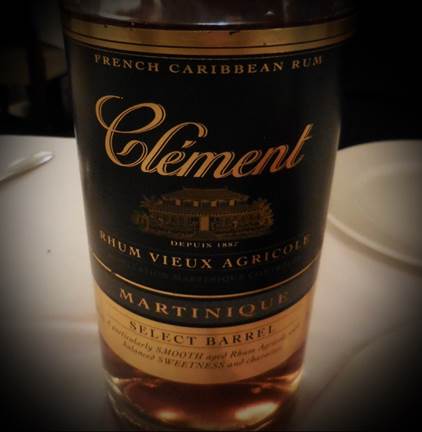
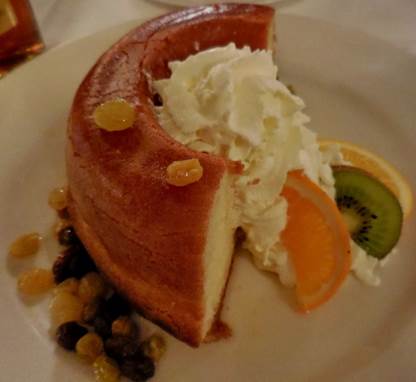
We’d just finished dinner. My tongue was tingling, in a good way. “It’s the rum,” I thought. “It is THIS rum, in particular.” I knew that the plain-bottled rum served with the baba au rhum at Le Café du Commerce did not create this sensation in my mouth. But the Clément rum served with the baba at Vin et Marée does it every time. I’m not a huge fan of rum, and I’m certainly not a connoisseur of the stuff. The only way in which rum has ever attracted me is as a component of baba au rhum, a dessert often served in good French restaurants. (Maybe I have too many bad memories of rum-and-cocacola served at parties when I was a teenager . . . .) A baba au rhum is usually served with some rum already poured onto the cake. But the bottle is brought to the table in case you’d like to add more. I usually do. I don’t like dry cake; I like cake soaked in rum much better! Now I’m learning that not all rums are the same. So what makes this Clément rum different? For one thing, I see the words “rhum agricole” on the label. Names on labels mean something in France. Appellations are important. Clément rum is made in Martinique, which is a department of France, with all the rights and responsibilities that come with that status. The government of France is strict about controlling appellations. Who has the right to put “rhum agricole” on their labels, and what does it mean? I did the research. Rhum agricole is the name for cane juice rum, meaning that it is rum made from sugarcane juice, not molasses. Molasses is a byproduct in the refining of sugar; most ordinary rum is made from this by-product. France created a bit of a crisis for cane sugar plantations when it started to make sugar from sugar beets, causing the price of sugar to drop dramatically. Cane sugar factories went into survival mode, and began to distill their sugar cane juice into rum. Now the AOC (Appellation d’Origine Controlée) Rhum Agricole Martinique is allowed to be applied to rum made on Martinique that meets certain Martinique standards. If that rum is aged for three years or more in oak barrels, it may then legally be called “rhum vieux,” or “old rum.” Clément is the most renowned of the rum distilleries in Martinique, although there are a dozen or so other distilleries there. According to the company history, Homère Clément, who purchased the sugar plantation in 1887, was the one who pioneered the current way of making pure rum from fresh sugar cane juice instead of molasses. Clément was a doctor, as well as the mayor of the town of Le François from 1885 to 1923. His politics were of the radical-socialist variety, and he served as the deputy for Martinique in the French National Assembly from 1902-1906 (yes, one could be mayor and deputy at the same time). Born in Martinique in 1852, his full name was Homère Charles Marie Hidulphe Clément. He was evidently an entrepreneur as well. In 1917, seeing the demand for rum, he created a distillery to meet that demand during World War I (an awful war that must have driven many to drink). After Homère Clément died in Paris in 1923, his son Charles took control of the company. Charles had been well prepared; he’d studied the art and science of distilling at the Pasteur institute. While his father may have pioneered the making of rhum agricole, it was Charles who first bottled it, exported it, and created the brand name Clément for this special rum – thus beginning the global marketing of rhum agricole. In 1973, George-Louis Clément succeeded his father Charles in running the company. His brothers, Jean-José and Marcel-André, worked on marketing the rum internationally. Today, Clément rum is distributed to over 60 countries. The Cléments sold the company to the Hayot family in 1986, keeping the historic property, Habitation Clément, “in Martinique hands.” In 1991, the Habitation Clément hosted the Mitterand-Bush Summit at the end of the Gulf War. This old Habitation is a listed, historic property (since 1996), open to visitors. Its 740 acres of grounds include a 42-acre botanical garden and art galleries. Some warehouses and other areas are dedicated to the collections and activities of the Clément Foundation, which has amassed documents about Caribbean culture. (Source: www.rhum-clement.com, Wikipedia, www.assemblee-nationale.fr )
|
Monday, August 18, 2014
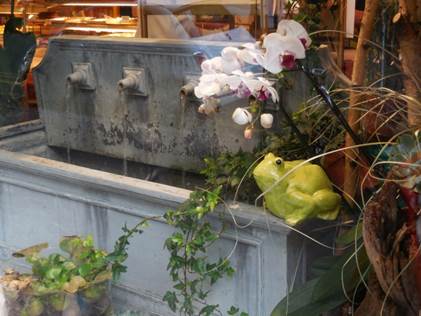
Odd window display at a bakery on the avenue Félix Faure.
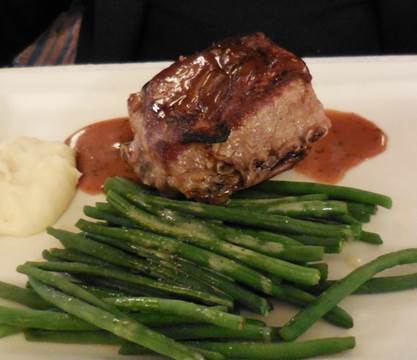
At Vin et Marée, Tom had a wonderful roasted lamb main
course with excellent green beans.
Mine was a fine sole meunière
(but not as good as Le Granite’s). Our
starter was an excellent croustillant
de gambas with tandoori sauce.
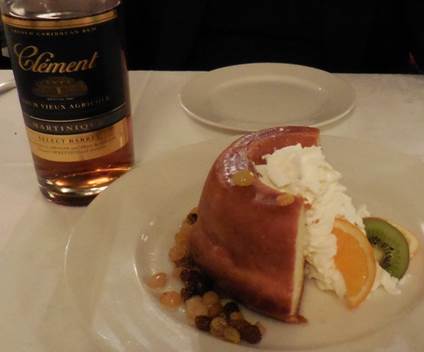
The baba au rhum at
Vin et Marée has the best cake and rum.
|