Paris Journal 2014 – Barbara Joy Cooley Home: barbarajoycooley.com
Find me on Facebook 2013
Paris Journal ← Previous Next
→ << Back to the beginning
|
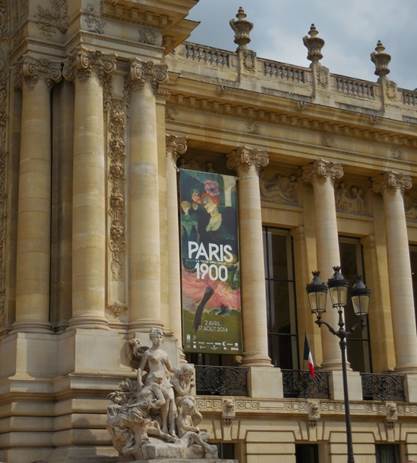
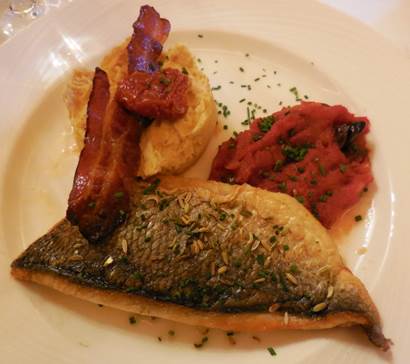
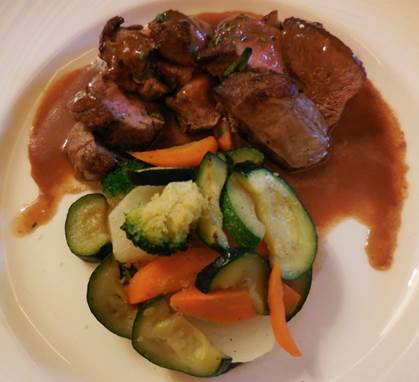
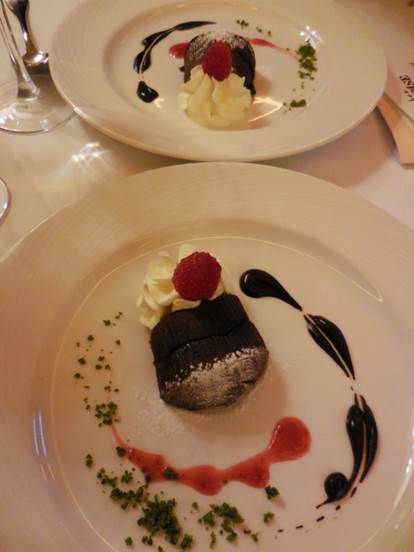
To save our strength for a big museum day, we took the metro rather than walk, as we normally would, to the Petit Palais. So we were early when we arrived and took our place in the very short line of waiting for entry to the Paris 1900 exhibition – the one for people with tickets. The other line was very long. We were so early for our 2PM booking that the attendant didn’t want to let us in yet. No problem. We just went in the entrance for the permanent collections and made our way up to the café. Tom had not eaten lunch, and I only had a piece of toast, so the café was a necessary preparatory step for seeing the exhibition. He ordered a pastrami bagel sandwich and we settled into seats at an inside table. Outdoors was a bit chilly and windy. Tom ordered a café gourmand, too, which was available right away as he went through the cafeteria line. (The sandwich is something a server brings out when it is ready; he looks amongst the tables for your numbered sign that you’re given when you pay for your order.) But as usual, Tom had to argue a little to get his coffee in advance of the meal, instead of afterward. Drinking coffee at the beginning of a meal is deeply disturbing to the French and Italians, in our experience. Yet that is often what Tom wants to do; for him, it can be a sort of aperitif. He was telling me about his tiny but ultimately successful argument when he brought the tray to our table that I was staking out. I said, “Next time, simply shrug your shoulders and say, ‘mais je suis americain.’” That seems to be a sufficient explanation for all kinds of strange behavior, in the eyes of a French person. So we started with dessert. Tom gave me the tiny cube of brownie because it had nuts in it (he isn’t eating nuts these days), and he ate the pudding and tiny cookies. The sandwich arrived, and when it was consumed, it was time for our entry into the special exhibition. We did not have to go back outside to the line. I asked the cashier in the lobby, showing our ticket, and she said we just go straight back to the exhibition entry. We must remember this for the future. No standing in outdoor lines in the chilly weather, no sir, not for us. We’ll buy our tickets online in advance, proceed directly indoors to the café, and wait in comfort for our entry time. The man at the entry for the exhibition scanned the bar codes on our tickets and then explained that he keeps the ticket; so once you’re in, you’re in. You cannot leave and come back. This is important to know, because the space dedicated to the special exhibitions is considerable. Allow plenty of time to see these shows. The Paris 1900 show was exceptionally well done. It showcases Paris at a sort of peek, when it truly was the leading city in art and fashion. No wonder it is such a popular exhibition among French people. We didn’t see many foreign tourists in the thick crowd at the show. All the expository plaques were in French, except for one paragraph of general explanation in each of the main galleries; those were in French, English, and Spanish, I think. The French people at the exhibition were taking it very seriously. Many were taking notes in little notebooks! Several were taking photos (no flash allowed), but that was hard to do with the crowds in every room. I didn’t even try. It took hours for us to go through the entire show. By the time we left the Petit Palais, it was an hour and a half before our dinner reservation across the river at Chez Françoise. We walked to the foot of the Pont Alexandre III and descended the steps to the riverbank where, lucky for Tom, a brocante was happening. Brocantes are like organized neighborhood garage sales or yard sales. This one is part of a series with a slight emphasis on near-antiques and collectibles. For this long holiday weekend, the brocante is on the riverbank at the foot of the Pont Alexandre III. Next week, it moves to Place Monge for a Saturday, and to Place Maubert for that weekend, and then to Avenue Felix Faure on the final weekend of August, where we’ll probably see it again. The weekend of our move over to the 6th, the brocante is in the 7th, on rue Cler, so we’ll see it yet again if we aren’t too busy. It was fun looking at all the bric-a-brac, and there were some booths with high-quality items like silver, wood furniture, and oriental rugs. We bought nothing, because it is generally too much trouble to bring the items home at the end of the summer. The oriental rug dealer could see our interest in his wares, but he was packing up, fearing that a downpour would happen momentarily. He offered a “tiny price” on anything we wanted. We didn’t want to get into explaining that we aren’t able to take any Iranian rugs back home with us because of an embargo. We just smiled and went on, and I assured the dealer that the “catastrophe” (downpour) was not about to happen soon. I was right about that. It happened later, after sunset. Calling it a “catastrophe” seemed especially absurd, on the day after the ten-year anniversary of Hurricane Charley hitting southwest Florida! Now that was a “catastrophe,” but it could have been worse. Nevertheless, several of the dealers feared the dark clouds. I said to Tom that there’s nothing wrong with dark clouds; it is only the dark clouds with streaks of rain under them that are a problem. After a half an hour, we gave up because the dealers were giving up, and we returned to the comfy lounge of the Petit Palais’ café. The Petit Palais, and its café, are open later on Thursdays ONLY when there is a temporary exhibition happening. So this was the last Thursday this summer that the Petit Palais would be open past 6PM. We took advantage. I staked out a couple of the really comfy chairs on the upper level of the café’s interior dining area, and Tom got in line for a bottle of Badoit and a glass of chardonnay – not overpriced at all. Then we had plenty of space and comfort in the warm, dry Palais to spend a half hour lounging before dinnertime. When it was time to go, we saw the kind of dark clouds that do mean rain (solid dark blue beneath the clouds) headed toward us. We quickened our pace to cross the Seine and reach the Aerogare Air France on the Esplanade des Invalides. I’ve always been mystified about just where the entrance to Chez Françoise might be. I read reviews of the mythic restaurant just to see if they offered any clues. They did, but I was still a bit mystified. Yet I followed the information gleaned from this research and it paid off; we found the way into Chez Françoise. You see, for years this resto lived off the business generated by the National Assembly (like the French House of Representatives) next door. You had to be “in the know” to find the place. Then the resto became part of the Tables Mousset chain which also owns La Bastide Odéon, one of our favorite places near the Luxembourg Palace (the home of the French senate). So now Chez Françoise is keenly interested in making a profit, yet still offering good French cuisine and refined service in an elegant setting. To find the entrance, go to the side of the Aerogare Air France building that faces the rue Esnault Peleterie. Once inside the building, take the steps downstairs. Yes, you are then sort of in the basement, but not really, because a road cuts down into the middle of that building, so there is another street level on the inside at a lower level. It is impossible to explain this in a way that makes sense. The restaurant has a terrasse under greenhouse glass covering, but nobody was being seated out there on this cool, windy night with rain threatening. We were given a fine table, and the dinner began with a little mis en bouche of a fantastic lobster bisque that was unusually rich and sweet. I still had half of my bisque when the first course arrived – a millefeuille of aubergine (eggplant) with ricotta. We split the millefeuille; the server brought a second plate without our even asking for one (which we never do). The millefeuille was gorgeously presented, and it was good, but a bit bland. I’m a good enough cook to recognize complementary tastes, and I knew my remaining lobster bisque would be an excellent sauce for bringing the millefeuille to life. So I poured it on. Tom was hoping nobody saw me do that. I don’t think they did, but I didn’t care. I was right. That touch made the millefeuille into a delight. I encouraged Tom to make the same adjustment, but unfortunately, he’d consumed almost all of his bisque. My main course was a filet de dorade with a purée of chickpeas and a purée of tomatoes and olives. Again, the dish was gorgeously presented. I adored the fish and the tomato-olive-garlic purée, which was expertly seasoned in a Provençale style. The puréed chickpeas were interesting, and maybe even good, but were a bit too heavy, starchy, and dry for me. I only tasted them. No matter – I had plenty of food. The bread served at Chez Françoise deserves mention. It comes as a bisquit-size individual loaf of country bread, with a crunchy crust and tasty, chewy interior. Best of all, it comes with real butter. You normally are not given butter unless you ask for it in Paris restaurants. At a few select places like Chez Françoise, it just arrives on the table automatically. I love that. When you finish the first course, the server offers another little loaf of country bread. Tom said yes, I said no. Tom’s main course was a filet mignon of veal, and it was superb. He loved the way the sautéed veggies were done, too. The dessert was visually exciting, and so sweetly divided onto two plates (again, without our asking), and so gorgeously presented on two plates, that I feel bad about having to say it was not the greatest. It was a moelleaux au chocolat that we think came out of a package; not fait maison. At any rate, it was far from a top-notch moelleaux. But for service and presentation, that dessert gets an A+. When the check arrived, the LaFourchette discount had not been applied. We had to politely point that out, and the headwaiter very politely and apologetically brought the corrected bill. The dinner was a bit of a celebration for us. Although we’ve had some sad news in the past week, we’ve also had very good news regarding work, the reduction of some property taxes, and the granting of the development permit for Cooley Hammock. With the elegant setting and exceptionally good service, the restaurant gave us the experience we were seeking. I hoped there was a way to go from the inside of the Aerogare building directly into the metro, and when I asked the doorman at the resto, he seemed to indicate that there was. We followed his instructions, and realized that no, we did need to go outside. It was raining. Fortunately I had a small, fold-up umbrella in my handbag. So I wrapped my arm tightly around Tom’s shoulders, and he wrapped his around my waist, and we moved like one four-legged creature in synchrony through the rain, under the little purple parapluie, over to the metro entrance. Inside the metro station, people where just standing around waiting for the rain to stop. The rain had pushed many people who’d normally walk home after dinner, like us, into the metro, so it was unusually full for that time of night. At the Commerce station, we exited in front of the Commerce Café, and became the four-legged creature again, moving up the rue du Commerce under the little purple parapluie. At home, we peeled off the semi-soaked clothing and arranged ourselves in lounging attire, ready for another evening of jazz piano music, playing softly on the stereo. I didn’t last long before I departed into dreamland, with visions of Paris in 1900 filling my head.
|
Friday, August 15, 2014
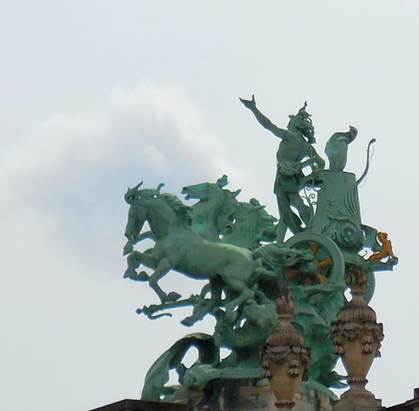
Statue atop the Grand Palais, which was built for the
Universal Exposition in Paris, held in 1900.
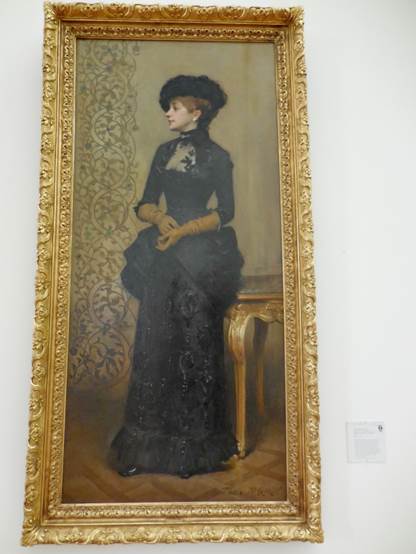
A painting called “Femme
aux gants” (Woman with gloves) and also fondly called “La Parisienne” by Charles-Alexander
Giron (1882) is one of the items in the permanent collections at the Petit
Palais that had been called out as a part of the Paris 1900 show as
well. The painter never parted with
this beloved work, which he called his “black diamond.” It was donated or sold to the museum by a
descendant.
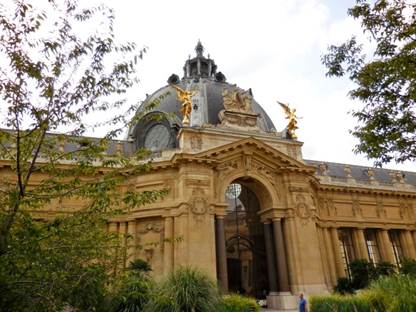
The dome of the Petit Palais as seen from the garden and
the café.
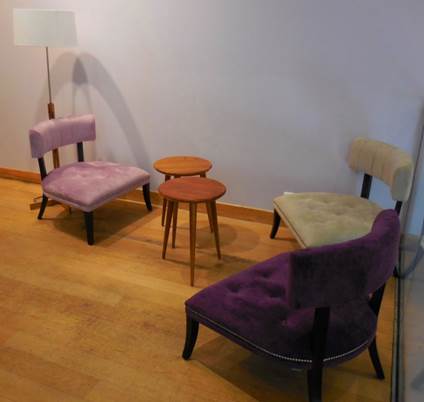
Comfy chairs where we like to lounge in the upstairs dining
area of the Petit Palais café.
An image from a Toulouse-Latrec painting was used in all of
the exhibition’s publicity. The
painting, Marcelle Lender Dancing the
Bolero in "Chilpéric", included in the show, is on loan from
the National Gallery of Art in Washington D.C. It is a part of the Mr. & Mrs. John Hay
Whitney collection.
Filet de dorade
(above) and filet mignon de veau
(below) at Chez Françoise.
Moelleaux
au Chocolat, so sweetly and beautifully divided onto two plates
for us. |