Sign
my guestbook. View
my guestbook. ←Previous Next→ Paris Journal 2007 Home
|
This
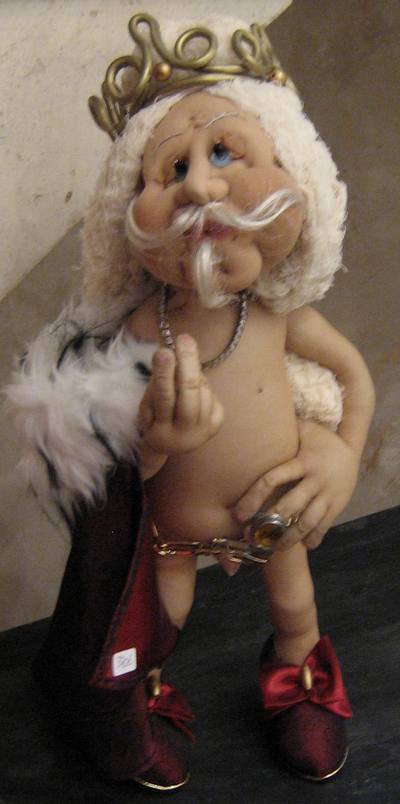
little guy, who resembles one of Katie Gardenia’s dolls, Pictures from
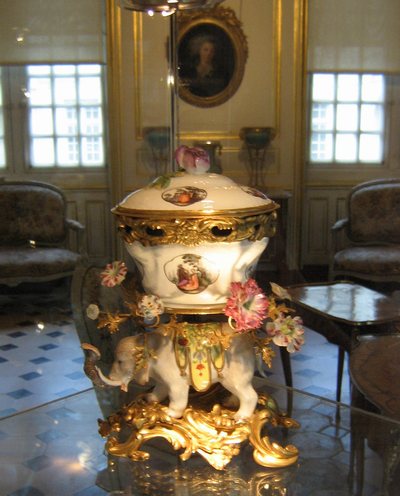
the Musée Cognacq-Jay
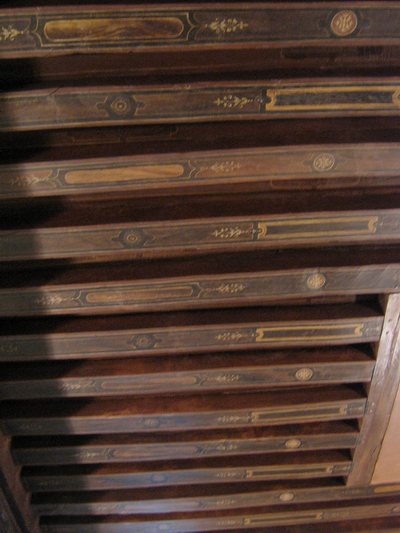
Beamed
ceiling in the Hôtel Donon, now the Musée
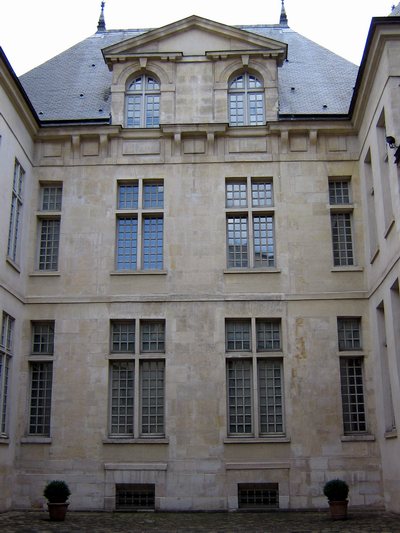
The 16th
Century Hôtel Donon. |
Wednesday, August 8 We went to the
Marais yesterday to see the Musée
Cognacq-Jay, one of the city owned museums that is dedicated mostly to 18th
Century art. The collection
was bequeathed to the city by Ernest Cognacq in 1928. Ernest and his wife, Marie-Louise Jay, came
from very modest backgrounds. They
founded the Samaritaine department store in Ernest and
Marie-Louise began collecting art in 1895.
They bought paintings, graphic arts, sculpture, furniture, rugs,
tapestries, and objets d’arts,
mostly focusing on the 18th Century, but also including some 17th
Century and 19th Century items.
They put the
collection in a building next to (or part of?) the Samaritaine de Luxe store
they had established on boulevard des Capucines (the original, main store is
on the The museum
includes well-known paintings by Chardin, Watteau, Boucher, Drouais,Tiepolo,
Wright of Derby, Reynolds, Lawrence, Fragonard, Canelletto, and Latour. There is a great collection of tables made
by ébénistes, You are NOT
allowed to use a flash (or a tripod) in the museum, but you can take photos. Info: Musée
Cognacq-Jay, 8 rue Elzévir, 3rd arrondissement, telephone
01.40.27.07.21. Nearby Métro
stops: Saint-Paul, Chemin-Vert, Rambuteau. Bus : 29, 69,
76, 96 Open from 10AM
to 6PM Tuesday through Sunday. Closed
Mondays and holidays. Last admission
is at 5:30PM. After spending
a enough hours in the museum to attract the curiosity of the staff, Tom and I
walked over to the Place des We had the foie gras (made there, and one order
is enough for two people), a basket of bread, a divine home-made apricot tarte
(keeping in mind that apricots are in season and are excellent right now), a
double coffee, a large 25-centiliter glass of chardonnay, a large bottle of
Badoit, and a carafe of water, all for €30 (tax and tip included, as always). We were eating at an odd time, 3:30PM, when
most places have stopped serving lunch.
But Café Hugo is open 7 days a week, from 8AM to 2AM, with non-stop
food service. Café Hugo is
at 22, Place des Then last night
Guy and Sheila took us out to dinner at Le Tire Bouchon (62, rue des
Entrepreneurs, 15th arr., telephone 01-40-59-09-27). It was excellent, as always. We were very impressed with Guy. He ordered, and ate in its entirety, the gourmand menu, which includes starter
course, two main courses (one fish and one meat) and the assorted dessert
plate. He and I (mostly he) consumed a
bottle of My starter
course was very interesting. It was
called a “céviche de dorade.” I had no
idea what a “céviche” was (it is not in the French dictionary or the
gastronomique dictionary), but I certainly know dorade. It is a fish, called sea bream by the
Brits, that is found in the Mediterranean and the My main course
was a very delicious plate of lamb morsels in a delicious sauce. Alas, Isabelle
and Laurent, the proprieters of Le Tire Bouchon, are going on vacation
starting Sunday, and they won’t be open again until early September. Laurent came
out to talk with us at the end of the evening. I told him about the Ratatouille exhibit we had just seen earlier in the day, as we
happened upon a gallery featuring it on the Ile St. Louis. The exhibit included fascinating concept
drawings of the various rat characters, plus photos of the Tom told
Laurent about the Deratiseur (rat exterminator) boutique featured in the film
– that it is actually based on a real such boutique in |