Sign
my guestbook. View
my guestbook. ←Previous Next→ Paris Journal 2007 Home
|
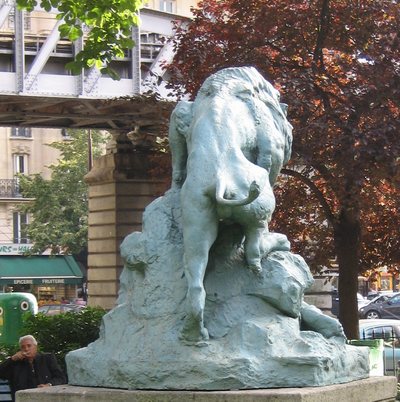
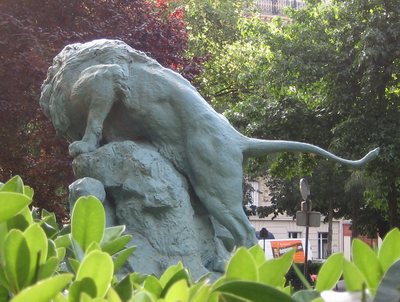
Lion
at Square Cambronne.
The
We’re
finally having some warm, summery weather (but
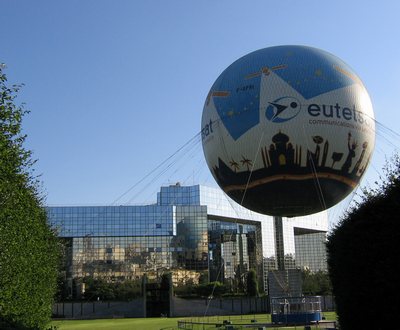
The balloon
at Parc André Citroën is being used again.
Even
though the weather is warm, we are not suffering
|
Wednesday, August 1 Well, I spent
the morning unexpectedly having to clean a number of bathroom fixtures, scrub
a bathroom floor, and even clean some bathroom walls. But then all was pretty much in order for
the arrival of my sister and brother-in-law, Carolyn and Doug, who will be
staying in the sixth arrondissement.
They were so tired when they arrived, but they still wanted me to show
them the nearest grocery store, bakery, wine shop, and recommended
restaurants. This I did, and I helped
them buy their initial groceries. I
admire their stamina. When we first
arrive from the We did indeed
have our dinner at Le Blavet last night.
That was with Tom’s side of the family, and it included Mary and Dan
(their last night in I did allow
myself to have that superb croustade
des escargots with creamy garlic and parsley sauce again. Oh it is just soooo good. Restaurant Le Blavet, 75 bis rue Now Mary and
Dan are off to After getting
Carolyn and Doug settled this morning, I walked all the way home, which
includes walking right past UNESCO, of course. That reminds me about an utterly stupid
decision made there recently – to remove
the
Imperiled Glades cut from watch listA U.N. committee downgrades the park, despite concerns.By CRAIG PITTMAN Last month, the U.N. World Heritage Committee
made headlines when it took The committee, charged with protecting irreplaceable landmarks of
outstanding universal significance, hailed the progress the The committee's decision went against the National Park Service's own recommendation and the U.N. committee's science advisers. "We said it should stay on the danger list because further work
needed to be done," said David Sheppard, who heads the Programme on
Protected Areas for the Switzerland-based However, Sheppard said, "the head of the The National Park Service's top scientist says politics drove the decision. "There's always been a kind of pressure from the Washington level to say, 'Okay, we've got a plan, now take us off the list,' " said Robert Johnson, director of the South Florida Natural Resources Center at Everglades National Park since 1995. "I think for the Bush administration, it was seen as a black eye to be on that list." Being taken off the list "gives people the impression that things are going well," when the restoration is actually decades away from achieving its goals, he said. For the past four years it has been the only American site listed as being in danger. Being on the list "focuses more international attention on what we do," Johnson said. Deputy Assistant Secretary of the Interior Todd Willens was the leader of
the Willens said that making the change was not the result of some political
agenda. In fact, it wasn't even his idea, he said. Instead, he said, before
the meeting, representatives from some of the 21 other countries on the
committee told him they wanted the So even though the National Park Service's own report recommended keeping
the He said he made the motion before any other country could jump in, because
"the The committee is the governing body of the 176-nation World Heritage
Convention, set up under a treaty initiated by President Richard Nixon. In
1973, the The committee takes inventory of all major world landmarks. It compiled a
list of 380 World Heritage sites, including Stonehenge and Twenty When the committee puts a site on its danger list, the goal is to call
attention to the threats facing the site. For instance, the Galapagos Islands
are being invaded by exotic species, and The committee put In 2000, Congress and the state Legislature approved a complex plan to
restore the Last year, on behalf of the U.N. committee, Sheppard of the IUCN visited "I thought the site, although there had been significant progress,
still faced significant threats," he said. That's why the IUCN
recommended the committee keep the Meanwhile, Johnson said, the park staff "put a lot of work into" creating a list of benchmarks that could be used to gauge their progress on dealing with the threats, such as curtailing the phosphorous pollution flowing into the park. But the committee's own staff noted this month that there are still concerns about water pollution in the park and urban development creeping closer to the park boundaries. "Various sources have emphasized that restoration is progressing very
slowly," the committee's staff wrote in a recommendation to keep the But when the committee heard Willens' motion, it went along with it. There
was no formal vote, Willens and Sheppard said, and no dissent. Willens said
that's because other sites on the list are in far worse shape than the
Everglades, such as one in "Some of the other sites are in war zones," he said. "This
way the Fast Facts: Endangered sites Some World Heritage sites classified as endangered: Galapagos Islands, ©
2007 • All Rights Reserved • |