Sign
my guestbook. View
my guestbook. ←Previous Next→ Paris Journal 2007 Home
|
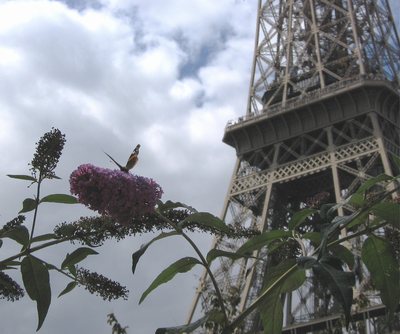
Butterfly
on lilac in the Champ de Mars.
The
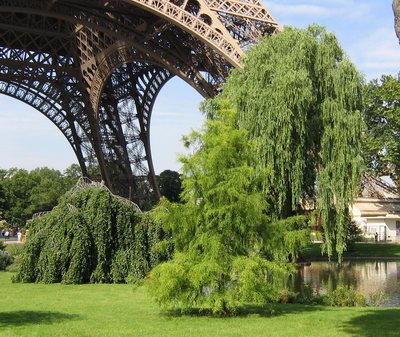
area to the immediate southwest of the
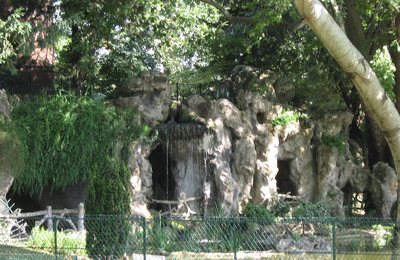
A
grotto with a little waterfall in the Allée de Refuzniks area.
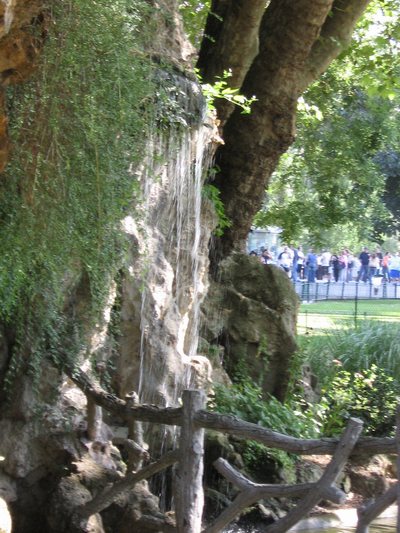
The
little waterfall, and the busy square under the tower
On the
other side of the tower is another peaceful area
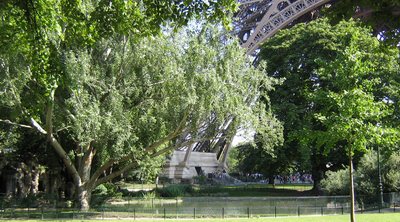
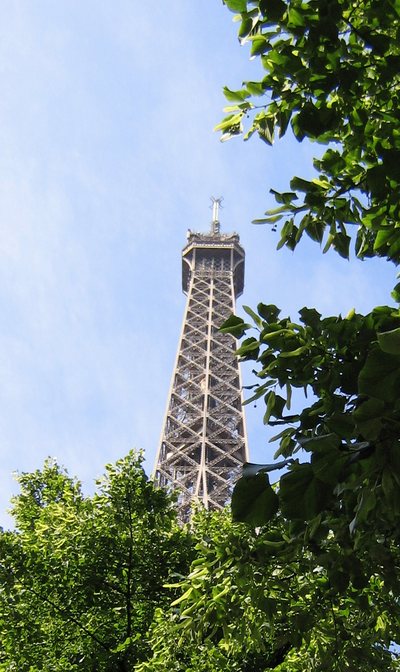
The tower
seen through the trees of the Allée Jean Paulhan. |
Tuesday, July 24 Yesterday
evening, we made a mad dash on the métro
to the FedEx office on boulevard Haussmann
to send one of Tom’s chapters off to his publisher in I just checked
on the tracking number. The package is
indeed still in St. Ouen, just to the north of After we
finished our business at FedEx, we had a leisurely, long, quiet walk down
through the 8th arrondissement, to the Champs Elysées,
which was absolutely wild with traffic and people. The walk was serene again after we crossed
that grand boulevard, until we reached the big intersection at Place de
l’Alma. We made our walk longer by attempting
to drop in on Dan and Mary on the rue Desaix.
They were not at home. So we
went on home so I could finish making dinner (sauce was prepared in the
afternoon). We just
received a travel update from Erhard, who is in Here is the
magazine’s brief explanation of the index: Big Mac
Index Burgernomics
is based on the theory of purchasing-power parity, the notion that a dollar
should buy the same amount in all countries. Thus in the long run, the exchange
rate between two countries should move towards the rate that equalises the
prices of an identical basket of goods and services in each country. Our
"basket" is a McDonald's Big Mac, which is produced in about 120
countries. The Big Mac PPP is the exchange rate that would mean hamburgers
cost the same in And here is a chart
from The Economist, dated July
5, 2007, which shows the current situation.
Sarkozy and I are correct. We
Americans are paying too much for the euro.
I wish the European Central Bank would wake up and do something
appropriate about this! It simply must
be hurting European exports. And so I
cooked Italian food last night. Dan
and Mary didn’t show up, so we have plenty of leftovers. I notice that there is a lot of grated
Emmental cheese sold in the groceries here.
Emmental is a type of Gruyère cheese
– the closest to what we call Swiss cheese.
Another type of Gruyère is Compté, and that is the kind I like
best. It is sharper, and tastes a tiny
bit like cheddar or Parmesan. It is
more expensive than Emmental, but less than Parmesan (at least, here in There is a
phrase that appears with some frequency on menus in French restaurants. It is “à la Savoyarde,” and it refers to
cuisine from southeastern Finding a very
nice shredder in the kitchen, I decided to shred Compté to serve with last
night’s pasta dish, which was already a fairly Provençale style, moving a bit
away from Italian. The results were
excellent, and the shredded cheese was beautiful – a pile of thin, curly
tendrils. There is no need to buy
expensive Parmesan cheese here. French
Compté will do very nicely. In fact,
I’d say it was even better. For best
results, use “Compté Extra,” which is a bit sharper than regular Compté. Here’s the
garlic report: Egyptian garlic is
milder than garlic grown in Well, it
finally happened again. The rickety
old hot water heater in the apartment here just gave out while I was cleaning
up after lunch. This water heater has
been a problem in prior years.
Fortunately, Reza, the “old Iranian plumber,” as the apartment owner
calls him, is not on vacation this time.
His shop is just down the street a bit, so Tom and I just visited him
and his two aging white Persian cats when the daily two-and-a-half hour lunch
hour was over. He promises to stop by
later. I think he must first arrange
for someone to sit in his shop while he’s out. I usually
don’t write about aspects of French culture that are written up in the International
Herald Tribune, because I know many of you read the New York Times,
and those articles are usually duplicated there. But there are two that I simply cannot
resist. First is the
weekly media chart that shows what the top 10 television shows (in terms of
viewership) are in It comes as no
surprise that all of the top 10 TV shows in the But in This is not a
general European phenomenon. In In And in I remember
that in prior years, the most popular show here in In spite of
all this mythologizing about French hating Americans, the truth is, they love
our culture. You see it in the
television they watch, and you hear it in the popular music they listen to. The other
fascinating IHT story about French culture was on the topic of the Nicolas
Sarkozy administration and its supposed anti-intellectualism. The event that precipitated this was the
Finance Minister, Christine Lagarde, telling the French people to stop
thinking so much and to “roll up their sleeves” and work more. In the Alain is a
philosopher, writer, and radio show host.
He claims that thinking IS work, and that it requires “setbacks,
suffering, a lot of sweat.” Alain is also among
the French intellectuals who think that Sarkozy should walk instead of jog,
because walking is more intellectual and jogging is not intellectual. Alain claims to be a Sarkozy supporter, but
he thinks that Sarko should abandon jogging, which Alain says is an
“undignified” pursuit. His radio show
guests agreed. They also mentioned
that Jimmy Carter and Bill Clinton were joggers. They did not mention, however, that George
W. Bush was a jogger until recently.
He had to give it up due to knee problems. Now, W rides a bicycle. That would be too much sacrilege to even
think about for the French, who love cycling as a sport. |